A Tackle Shop Guide to Medium - Large Surface Lures
(Fresh and saltwater)
Stepping up to medium and large surface lures requires a shift in mindset. You are no longer "finessing" a bite; you are provoking a territorial strike or a high-energy predatory chase. Success with these larger profile surface fishing lures depends on matching the lure's action to the water's surface energy and ensuring your hardware is up to the task of a heavy-tackle battle. This guide covers the technical essentials for both freshwater and saltwater fishing applications.
A Note From Our Local Experts
"I often see anglers heading off on bucket-list trips and purchasing up big on lures—whether it's to chase Barra in the NT or heading out to a local haunt like Bass Point for Kingfish. One thing you shouldn’t be is being under-gunned. A metre-long Murray Cod or a 15kg Kingy could find the weakest point in your system in seconds. Make sure you have the approproate rod, reel and leader system.
I’ve personally spent several sessions throwing surface lures in both fresh and saltwater, and talked surface fishing with a lot with customers over the years, learning not only from my own experience, but their feedback, and my biggest takeaway is about strike timing. With the 'suction' strike of a Cod or Barra, if you strike the moment you see the splash, you'll pull the lure away at a critical moment. You're best off waiting until the rod actually loads up. It takes discipline to stay calm when the water explodes, but that's what puts fish on the brag mat."
- Ben Czulowski, Owner, Fishing Tackle Shop (Ocean Storm)
Surface Mechanics: Poppers vs. Stickbaits
The "noise", other than the rattles that a medium or large surface lure makes, is actually water displacement. Choosing the right displacement profile is the first step in your technical setup to chasing larger fish on the surface in both fresh and saltwater.
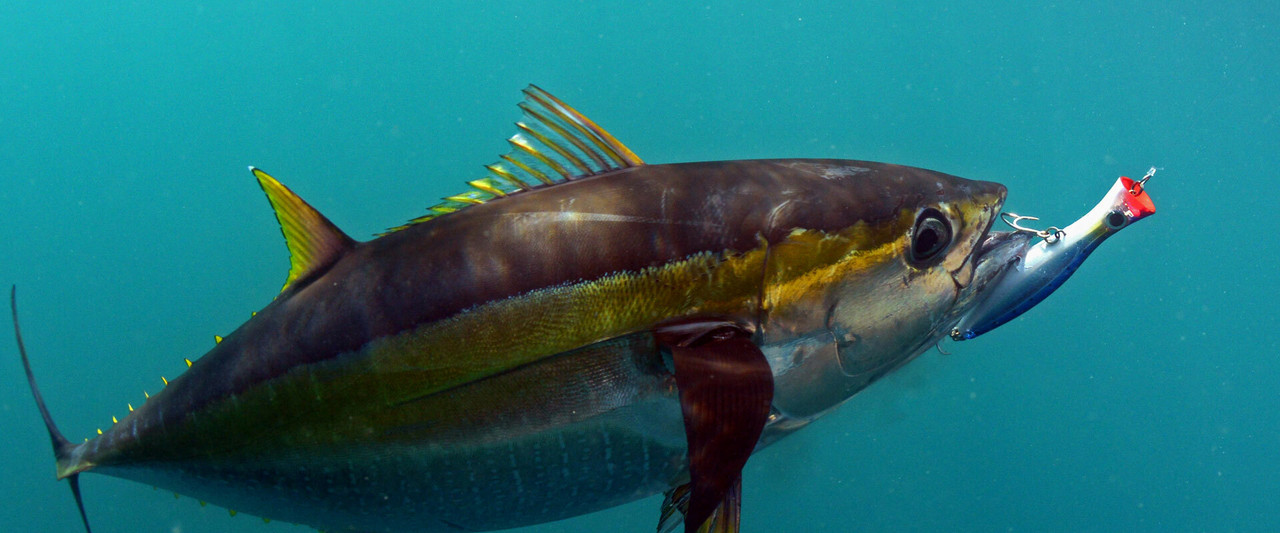
- Large Poppers (Cup-Faced): These are designed to move a large volume of water forward, creating a loud 'bloop' or a massive splash. They are a top choice for calling pelagics like Tuna and GTs from the depths or for use in heavy wind-chop where a subtle lure may go unnoticed.
- Stickbaits (Sub-Surface & Walkers): These have a more aerodynamic, tapered nose. They are often designed for a 'sliding' side-to-side action. Because they are more subtle, they are often the superior choice for educated fish in clear water or for Barramundi sitting in tight structure.
- Surface Paddlers & Crawlers: These feature large "wings" or wide bibs that create a rhythmic, 'paddling' wake. This constant vibration is a specific trigger for Murray Cod, mimicking a struggling land animal or large bird on the surface.
Technical Focus: Hardware and Buoyancy
When you upgrade hooks on a 150mm+ lure, you are adding significant weight. On a surface lure, this can be disastrous if not calculated.
✔
The Hook Balance: If you swap standard trebles for 4X or 5X strong replacements from
Owner or BKK, always test the lure in a bucket first. A lure that was a "floater" can easily become a "sinker" with the wrong hooks. For pelagics, many anglers now switch to a single
inline hook on the belly to reduce leverage and improve the lure's swimming action. The other advantage is that it is often easier to de-hook a fish with a single hook.
✔
Through-Wire Construction: For targeting larger species, especially bluewater fish using lures in this category, we recommend checking the specs in each listing and picking lures with a full through-wire design. This means the tow point and the hook hangers are all one continuous piece of often stainless steel wire. This prevents a powerful fish like a tuna from literally pulling the lure apart.
Pro-Tips for Big Surface Strikes
- The "Boof" Delay: For Barra and Murray Cod, the strike is a vacuum-like suction. Wait 1-2 seconds after the visual hit before you set the hook. This ensures the fish has more than likely fully inhaled the lure into its mouth.
- Rod Angle for Casting: Because these lures are often heavy (30g to 100g+), your rod angle during the cast is critical. Cast with a smooth, side-arm motion rather than a sharp overhead snap to prevent "crack-offs" and to achieve the best distance.
- Leader Management: For toothy pelagics like Mackerel, a short length of single-strand wire is essential. However, for Cod and Barra, a thick Fluorocarbon leader (50lb to 80lb) is preferred as it provides better abrasion resistance against snags without killing the lure's action as much as wire.
Frequently Asked Questions
What is the best colour for surface fishing for Pelagics?
When a fish is looking up against a bright sky, they see a silhouette. For bright, sunny days, natural "baitfish" patterns like blue, silver, or translucent work well. However, in low light or very rough water, a solid or dark coloured lure provides a much sharper silhouette that is easier for the fish to track and smash.
Can I use my standard overhead reel for casting these lures?
You can, but modern heavy-duty spinning reels or "large-frame" baitcasters (300 or 400 size) are generally more efficient for the repetitive casting required. Ensure your reel has a high-quality, high-drag rating, as a 90cm+ fish on the surface will put immediate, violent pressure on your drag stack.
Is it worth upgrading split rings on large surface lures?
Yes, absolutely. The split rings are often the forgotten link. For species like GTs or Kingfish, we recommend checking the quality and brand of the split rings included with your lure. While most lure brands these days, especially premium brands, use top quality hardware already, checking and upgrading to heavy-duty split rings can be an advantage. A standard ring can be opened like a paperclip by a high-torque fish during a long fight.