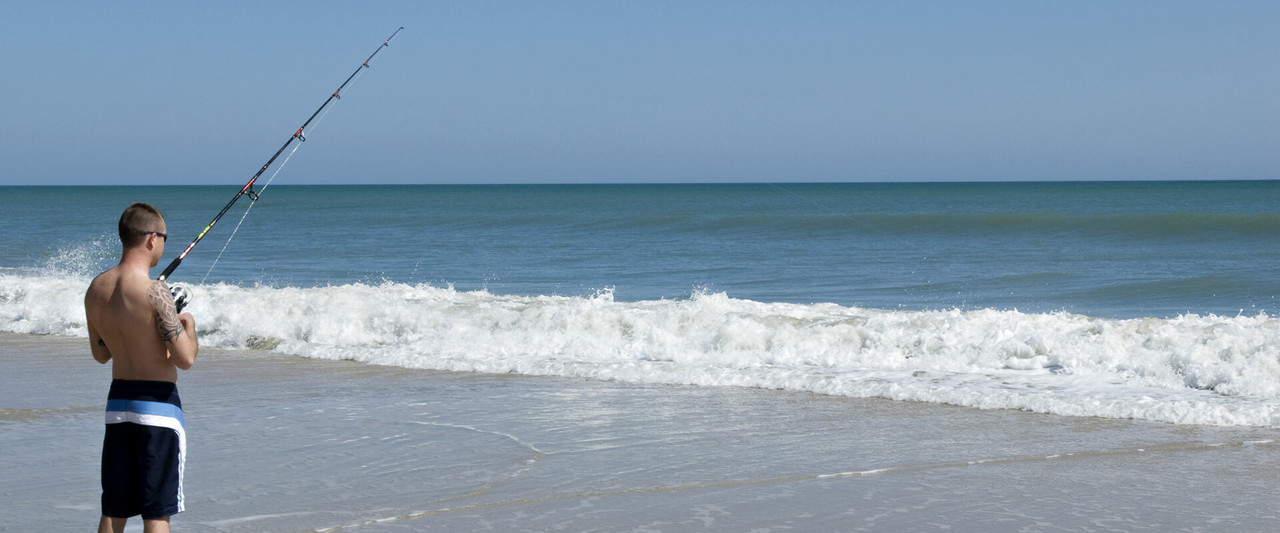
A Tackle Shop Guide to Surf Fishing Rods
Fishing the beach is a constant battle against water movement. You are dealing with lateral sweeps, rolling shore dumps, and onshore headwinds that try to push your tackle back onto the beach shore. A dedicated surf rod is designed to give you maximum leverage to launch heavy weights and baits with these obstacles in mind.
A proper surf rod also acts like a physical tower to help keep your line elevated out of the turbulent whitewash. Getting this right comes down to matching the length and the blank material to the specific gutter you are standing in front of.
A Note From Our Local Experts
"I have spent a lot of time on the sand at Bombo Beach here in the Illawarra. One of the biggest shifts I've seen over the years is anglers moving away from old, heavy fibreglass rods. Those old 'pool cues' will completely fatigue your shoulders and lower back after an hour of casting.
Modern graphite rods are significantly lighter, but the real advantage is how they actually fish. They load up to cast much further, and that stiff carbon transmits the subtle 'tap' of a bite straight to your hand. That sensitivity is crucial when crashing waves are constantly hitting your line and masking the feel of the rig. Just be careful how you land fish from the beach with graphite rods, never deadlift heavy species like Australian salmon or tailor.
For open beaches, I consistently find that 12ft is the sweet spot for balancing casting distance with physical manageability. If you want a high-end blank, I point people toward Daiwa. But for brands that offer sheer reliability and affordability day in and day out, Penn and Shimano are where I steer most of our customers."
— Ben Czulowski, Owner, Fishing Tackle Shop (Ocean Storm) | 20+ years industry experience
Technical Details of Most Surf Fishing Rods
Understanding how a beach blank is built explains why it handles a 100-gram sinker differently than a standard rod.
✔
Blank Material (Graphite vs. Composite): Modern graphite is highly rigid, delivering long-distance casting and sharp bite detection. However, it is brittle if bent at an extreme angle. Composite or fibreglass blends are physically heavier but act as excellent shock absorbers, allowing a cautious mulloway to mouth a bait without feeling immediate resistance from the rod tip.
✔
Rod Length as a Lever: It is not just about clearance. The length of a 12-foot or 13-foot surf fishing rod acts as a mechanical lever. It allows you to generate significant tip speed on a smooth casting sweep, physically launching heavy rigs much further than a short, stiff boat rod could ever manage.
✔
Oversized Guide Rings: Surf fishing rods usually feature large-diameter guides, particularly the 'stripper' guide nearest the reel. This reduces line friction when thick monofilament or heavy braid spirals off a large spinning reel spool during a high-energy cast, preventing wind knots.
Pro-Tips: Casting and Handling on the Sand
- The Landing Slide: As Ben noted, never try to dead-lift a heavy salmon, tailor, or ray up a steep beach bank with a graphite surf fishing rod. Walk backward, keep the rod tip low, and use the momentum of a receding wave to slide the fish onto the dry sand, taking the physical pressure off the delicate rod tip.
- Check Your Joints: Before casting a heavy sinker, check that the two pieces of your rod are firmly twisted together. A loose ferrule joint is the fastest way to split the carbon fibre under the intense stress of a surf cast.
- Keep the Reel Out of the Sand: Sand is the enemy of spinning reel gears. When baiting up, never rest the rod and reel in the sand. Always use a PVC or aluminium sand spike to hold the rod vertically while you work.
Surf Rod Length Application Guide
Match your rod length to the size of the surf and your target species.
| Rod Length |
Target Environment |
Common Target Species |
| 10 Foot (3.0m) |
Close gutters, sheltered beaches, spinning metal lures. |
Tailor, Salmon, Bream, Whiting |
| 12 Foot (3.6m) |
The standard all-rounder, medium surf and channels. |
Tailor, Salmon, Mulloway, Dart |
| 13 to 15 Foot (4.0m+) |
Heavy shore break, launching baits to distant outer gutters. |
Large Mulloway, Gummy Sharks, Rays |
Swipe →
Frequently Asked Questions
Why do modern graphite surf rods snap when landing a fish compared to my old fibreglass rod?
It comes down to a user error known as "high-sticking." Old fibreglass rods bent all the way down to the butt, making them incredibly forgiving of bad angles. Modern graphite is a stiff, fast-action lever designed for massive casting distance. If you point a graphite surf rod straight up at the sky (past 90 degrees) to drag a heavy salmon up a steep beach bank, all the weight transfers directly to the fragile tip section, snapping it instantly. You must keep the rod low and use the receding waves to slide the fish up the sand.
What is the exact difference between a "Low Mount" and a "High Mount" surf rod?
This is a massive point of confusion for beginners. A "Low Mount" puts the reel seat right down near the butt of the rod. It is built specifically for Alvey side-cast reels, where your hand guides the line above the reel. A "High Mount" places the reel seat further up the blank, and is built specifically for standard spinning (threadline) reels. Putting a spinning reel on a low mount rod completely ruins your casting ergonomics and makes the rod feel incredibly unbalanced. Our surf rods for sale are built for spinning reels.
My rod says "Cast Weight 60-120g". What happens if I use a 150g sinker to hold bottom in a heavy sweep?
A surf rod is designed to "load" (bend like a bow) under a specific weight range and spring back to launch the rig. Overloading it with too much lead translates to really sloppy action, which actually kills your casting distance. More importantly, whipping an overloaded rod puts extreme stress on the top half of the carbon blank, risking a snap. If your rig won't hold in the sweep, the solution is not adding more dead weight; it is switching to a grapnel or star sinker that physically bites into the sand.
Is a 2-piece surf rod weaker than a 1-piece rod on a heavy cast?
Twenty years ago, brass sleeves or cheap fibreglass ferrules were a genuine weak point. Today, modern carbon-wrapped joints (often spigot ferrules) actually reinforce the connection point. This means a modern 2-piece or 3-piece surf rod gives up practically zero casting power compared to a 1-piece blank, while allowing you to transport a 12-foot rod in a standard car without snapping the tip in the car door.