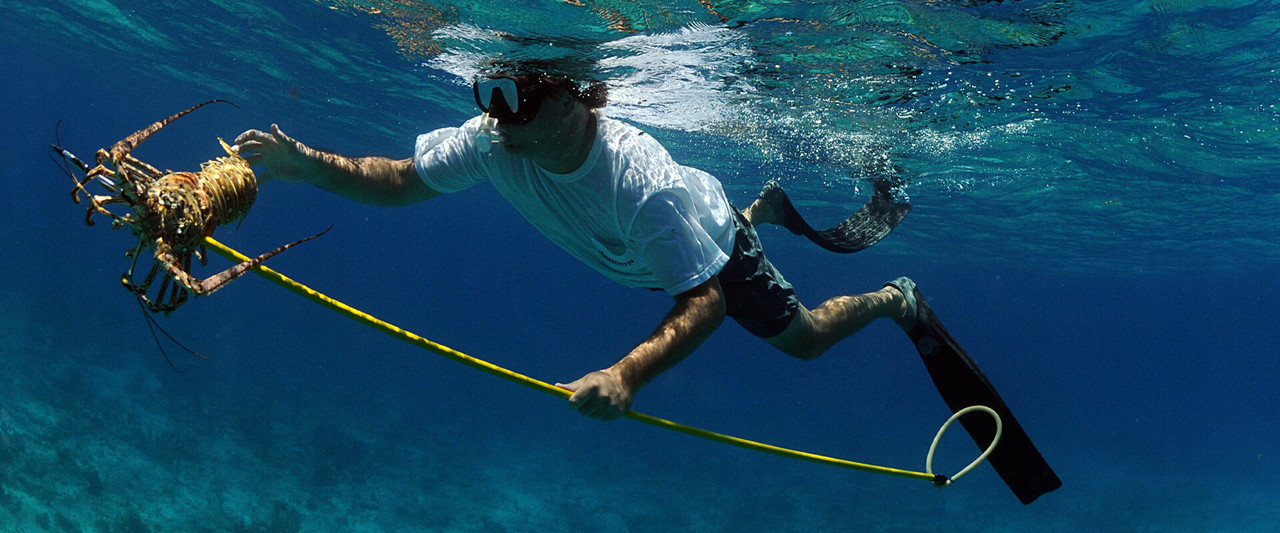
A Tackle Shop Guide to Hand Spears
A hand spear is exactly what it sounds like — a shaft you hold, aim, and thrust by hand at a fish to catch it. There is no propulsion mechanism beyond your own arm and the rubber sling. That simplicity is what makes hand spears a practical starting point for anyone new to spearfishing. Hand spears come at a relatively low cost, and there are no complex mechanisms to service compared to spearguns. The trade-off is effective range — hand spears require you to get close to fish, which is a skill in itself.
A Note From Our Local Experts
"I see young guys and beginner spearos come into the shop every now and again wanting to buy a massive timber speargun for their first time in the water. The wow factor of having a big speargun often overwhelms their judgement of the practicalities. I always recommend starting out with a hand spear first. If you dive around our local Illawarra headlands, you quickly realise that a hand spear teaches you the actual skill of diving and spearfishing—moving silently, hiding behind kelp, and stalking a fish until you are within two metres of it.
I stock and personally recommend Land and Sea hand spears. I have been selling this brand for over 20 years because they are a reliable, affordable option. When it comes to the decision between aluminium and fibreglass, I consistently point locals toward the fibreglass models; the extra physical weight in the fibreglass shaft gives the spear significantly more punch to penetrate thick scales compared to the lighter alloy models."
— Ben Czulowski, Owner, Fishing Tackle Shop (Ocean Storm) | 20+ years industry experience
Decoding Hand Spear Options and Parts
Every part of a hand spear has a specific purpose. Here is why the materials and parts matter.
✔
Fibreglass Shafts: The dense mass of fibreglass transfers more kinetic energy into the target on impact, producing deeper penetration. Heavier to carry than aluminium, but that weight is the point.
✔
Aluminium Shafts: Lightweight and corrosion-resistant. Less driving impact than fibreglass, but easier to handle over a long session and practical for travel — Our multi-piece options break down small, weigh very little. Ideal for travel.
✔
Cluster Tips (Prongs): A hand spear travels slower than a speargun shaft through the water column. A single-point tip at that speed can tear through a fish rather than securing it. A cluster of multiple prongs spreads the impact and physically pins the fish, which is why virtually all hand spear tips use this design concept.
✔
Hawaiian Sling Rubber: The latex rubber loop that propels the spear. It is a consumable — the physical stress of repeated stretching and UV exposure degrades it over time, regardless of use. Replacement is routine maintenance, not a sign of a defective product. It is recommended to buy a couple to keep handy.
Pro-Tips: Hand Spear Maintenance & Technique
- Unseizing a Salt-Locked Joint: If a multi-piece spear will not unscrew, never use metal pliers directly on the shaft — the concentrated pressure will crush or gouge the tube. Seized joints are caused by dried salt crystals locking the threads. Soak the joint in hot (not boiling) tap water for ten minutes to help dissolve the salt, then put on rubber dishwashing gloves or any other gloves that provide a firm slip-resistant grip and twist the sections apart.
- The Half-Twist Loading Technique: When stretching the rubber sling forward to load the spear, give the rubber a half-twist around the shaft as you grip it. This stops the long shaft from bowing outward under tension and ensures the spear flies straight on release.
Hand Spear Material Application Guide
Match the shaft material to your diving environment.
| Spear Material |
Primary Advantage |
Target Environment |
| Fibreglass |
Maximum momentum and penetration on impact. |
Coastal rock areas, targeting larger reef fish. |
| Aluminium |
Light, corrosion resistant, easy to carry. |
Targeting small reef species. |
| Multi-Piece |
Breaks down for transport and storage. |
Fitting in a large dive bag, car boot, or luggage. |
Swipe →
Frequently Asked Questions About Hand Spears
At what point should I upgrade from a hand spear to a speargun?
You will generally know once you have mastered hand spearing and ready to progress to the next level. Once your breath control and stalking are dialled in, and your interest has shifted from chasing basic fish like bream and flathead to fish that sit just beyond arm's reach — kingfish cruising a ledge, snapper holding in the current. A hand spear has done its job at that point. It has taught you how to dive and spear in a basic way. A speargun is what closes that gap and moves you on to chasing pelagics and more powerful demersal fish.
How do I know when it is time to replace my hand spear rubber?
Do not wait for it to snap mid-dive — that is the wrong way to find out. Before each session, inspect the rubber near the knot and attachment loop for visual signs of damage. Micro-tears, sticky texture, discolouration, or a rubber that feels like it has lost its snap are all signs it is done. Replacement sling rubber is inexpensive to replace.
Why did the prongs on my cluster tip bend, and can I fix them?
They bent because they hit rock — either after passing through a fish or on a missed shot. It happens to everyone. Straightening minor bends with pliers is often fine once. The problem is that bending metal work-hardens it at the kink point, so if you bend it again, it is likely to snap clean off on your next dive. Keep a spare cluster tip with you — they are inexpensive, and a snapped prong mid-session can be a little frustrating.
Does a multi-piece hand spear perform differently to a single-piece?
Marginally. The screw joints create a slight flex point that a solid shaft lacks. In the water, chasing reef fish at close range, you will not notice it too much. The convenience of being able to unscrew the spear and pack it into a dive bag or the boot of your car far outweighs that minor flex for most divers.
How close do you need to get to a fish to use a hand spear effectively?
One to two metres — realistically within arm's reach plus the shaft. That sounds hard, but reef species make it possible. Sweep, wrasse, luderick, and small snapper holding in kelp or tucked under a ledge will often sit still for you if you move slowly and use the reef as cover. Open-water fish are a different story. If the fish you are after will not let you get close, a hand spear is the wrong option; a speargun will serve you better.